
We are pleased to share our summary of Japan’s inbound travel trends for 2023.
In March 2023, the Japan Tourism Agency announced a new Tourism Nation Promotion Basic Plan aimed at revitalizing Japan’s tourism industry in the post-COVID era. The plan outlines three key strategies:
- Sustainable Destination Development Strategy
- Inbound Tourism Recovery Strategy
- Domestic Travel and Exchange Expansion Strategy
Using the latest available data from 2023, we review current progress toward the government’s 2025 targets and reflect on these trends in comparison with MIMARU’s performance.
●Inbound Tourism Recovery Targets under the “Tourism Nation Promotion Basic Plan”
(Selected Highlights) and Current Progress
| Category | Target Timeline | Target | 2023 Progress |
| Inbound Tourism Spending | Early achievement | ¥5 trillion | ¥3.6 trillion (cumulative Jan–Sep) |
| Number of International Visitors to Japan | By 2025 | Exceed 2019 level (31.88 million visitors) | 19.89 million (cumulative Jan–Oct) |
| Average Spending per International Visitor | By 2025 | ¥200,000 per person | ¥210,000 per person (average Jan–Sep) |
● In October, the total number of international guest nights reached11.8 million, and the number of international visitors to Japan totaled 2.51 million — both exceeding 2019 levels.
Cumulatively, from January to October, the number of international visitors reached 19.89 million, signaling a strong recovery and surpassing the 20 million mark within 2023.
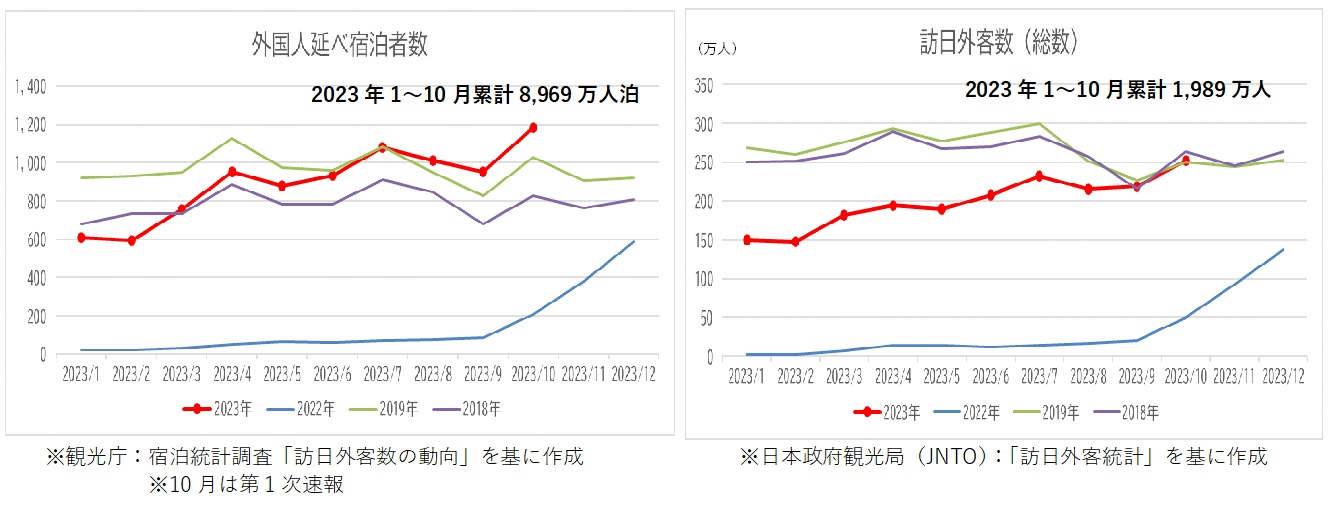
International Guest Nights (Left)
Cumulative Jan–Oct 2023: 89.69 Million
Source: Japan Tourism Agency, “Accommodation Travel Statistics Survey” (International Guest Nights Data)
International Visitors to Japan
Cumulative Jan–Oct 2023: 19.89 Million
Source: Japan National Tourism Organization (JNTO), “Visitor Arrivals Statistics”
Following the announcement of eased entry restrictions in September 2022, MIMARU experienced a four- to fivefold surge in reservations from international guests. Currently, overseas travelers account for approximately 90% of our guests, and an increasing number of our locations are now exceeding pre-pandemic occupancy levels.
At MIMARU, approximately 90% of our guests are international travelers.
Based on the total number of visitors to Japan,
roughly 1 in every 65 travelers (1.5%) chose to stay at MIMARU.
In particular, among visitors from Australia, approximately 1 in every 16 travelers (6.1%) stayed at MIMARU.
| Country / Region | JNTO Visitor Arrivals | MIMARU Guests | Share |
| United States | 1,677,900 | 40,797 | 2.4% |
| Canada | 350,400 | 10,168 | 2.9% |
| Australia | 464,000 | 28,090 | 6.1% |
| Taiwan | 3,399,400 | 74,292 | 2.2% |
| Hong Kong | 1,662,800 | 32,133 | 1.9% |
| Singapore | 391,500 | 14,945 | 3.8% |
| Indonesia | 323,500 | 9,827 | 3.0% |
| Overseas Total | 19,891,100 | 303,317 | 1.5% |
Footnote: * Jan–Oct 2023 cumulative data
Source: Japan National Tourism Organization (JNTO), “Visitor Arrivals Statistics”
●International travelers account for approximately 20% of total overnight stays nationwide.
In major urban areas, this proportion rises significantly to 30–40%.
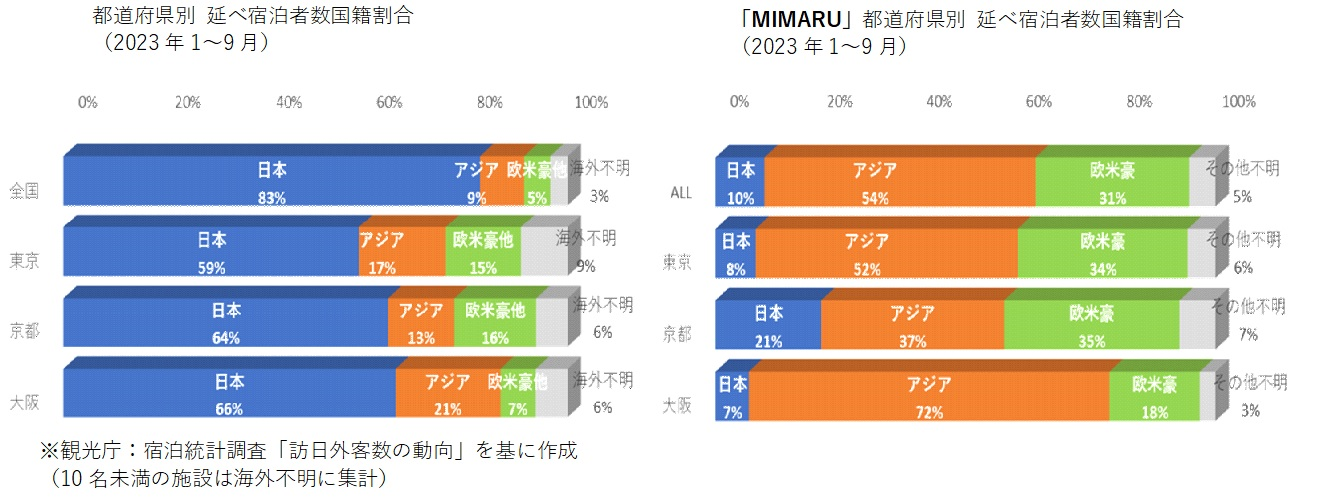
At MIMARU, the share of guests by nationality has generally returned to pre-pandemic levels. However, the proportion of international guests in the Kyoto area has slightly declined.
In Osaka, approximately 70% of guests come from Asia, with a growing number of repeat visitors to Japan.
Note: MIMARU Osaka was not yet open before the pandemic.
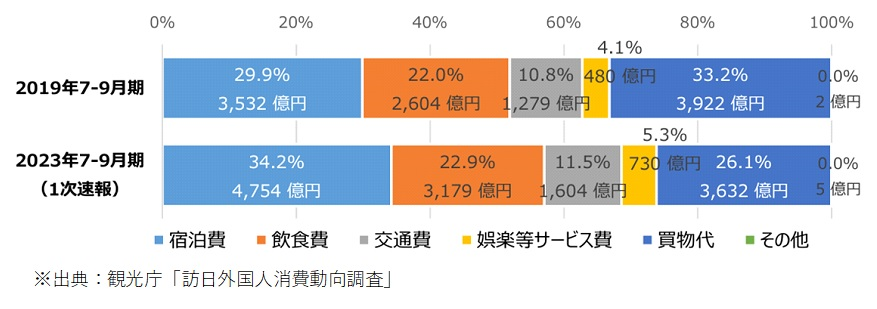
Preliminary estimates show that inbound visitor spending in Japan for the July–September 2023 period reached ¥1.3904 trillion, marking a 17.7% increase compared to the same period in 2019.
Cumulative spending from January to September totaled ¥3.6 trillion, demonstrating strong progress toward the government’s annual target of ¥5 trillion.
Average per-visitor spending during the July–September period rose to ¥210,000, a 29.4% increase compared to the same period in 2019.
The January–September average also reached ¥210,000 per person, exceeding the government’s target of ¥200,000.

According to MIMARU staff, “Theme parks and major tourist attractions remain consistently popular among our guests. However, we have seen more travelers venturing beyond Tokyo to destinations such as Mt. Fuji, Yamanashi, and Kamikochi. There has also been an increase in guests staying for over a month, as well as those seeking unique experiences such as animal cafés.”
Staff also noted that “Many guests comment that Japan feels more affordable due to the weak yen.”
In terms of shopping trends, “Purchases of beauty products, cosmetics, confectionery, and luxury brands have increased, while the volume of electronics purchases appears to have declined.”
MIMARU Performance Update
With international travelers accounting for approximately 90% of our guests, MIMARU faced significant challenges during the COVID-19 pandemic. However, following the easing of entry restrictions in September 2022, the number of overseas guests increased rapidly.
Amid the continued depreciation of the yen, average daily room rates have risen accordingly. As a result, RevPAR (Revenue per Available Room), a key indicator of revenue performance, has increased to 1.4 times the 2019 level.
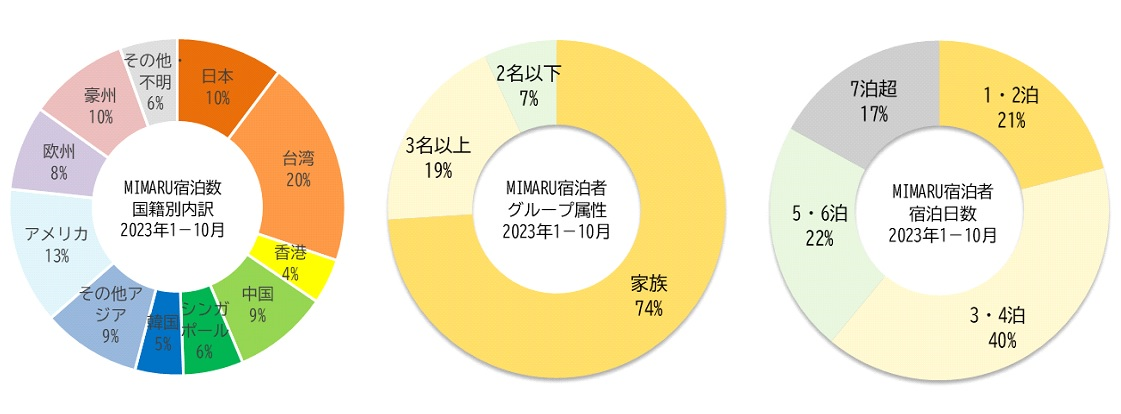
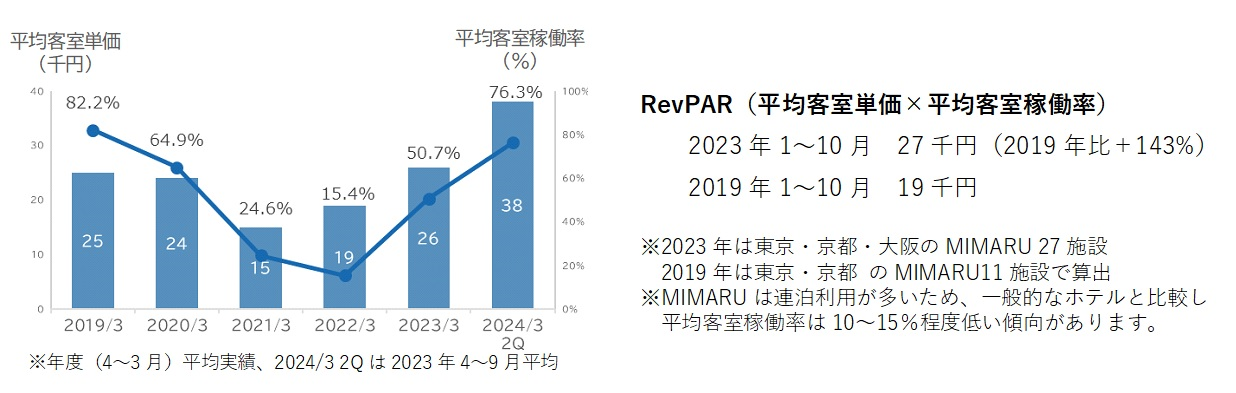 Guest demographics have largely returned to pre-pandemic patterns. From January to October 2023, the breakdown by nationality was approximately 10% Japan, 50% other Asian countries, and 40% other regions.
In terms of travel party composition, families accounted for 70% of guests, groups for 20%, and others for 10%. The average length of stay was approximately 3.4 nights, reflecting our intended target market of families and groups seeking mid- to long-term stays.
 According to the UNWTO (United Nations World Tourism Organization) World Tourism Barometer, international tourist arrivals reached 700 million from January to July 2023, representing a 43% increase compared to the same period in 2022.
Global tourism has steadily recovered to 84% of pre-pandemic (2019) levels, reflecting a 16% decrease compared to 2019.
According to the UNWTO Confidence Index, the outlook for September to December 2023 indicates that the recovery in global tourism is expected to continue, albeit at a more moderate pace following the peak travel season from June to August.
In particular, the report highlights that pent-up demand and the continued expansion of air routes in the Asia-Pacific region — where recovery has been relatively slower — are expected to drive further growth.
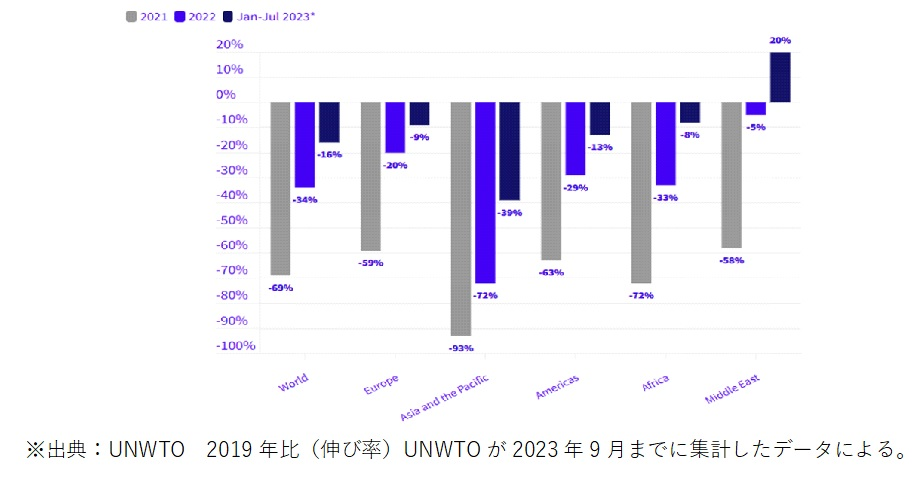 Source: UNWTO
Year-on-year change compared to 2019 (%)
Based on data compiled by UNWTO through September 2023.