
~Interviews with International Wheelchair Users & Company-wide Certification in Universal Manners (Level 3) ※1~
Cosmos Hotel Management Co., Ltd. has identified three key sustainability themes that it aims to advance together with everyone involved in MIMARU — Diversity in People and Workstyles, Connections with Guests and Local Communities, and Environmental Responsibility. The company actively shares its initiatives and progress in these areas.
This time, under the theme of “Connections with Guests and Local Communities,” we are working toward becoming a hotel where everyone can feel safe and comfortable staying.
As part of this initiative, we interviewed Joshua Grisdale (Josh), a Canadian advocate who shares travel accessibility information online for international travelers with disabilities, to gain insights into what travelers with disabilities are seeking when visiting Japan.
Furthermore, in order to apply these insights to our operations, we will begin an initiative in March 2024 to have all employees obtain the Universal Manners Certification (Level 3).
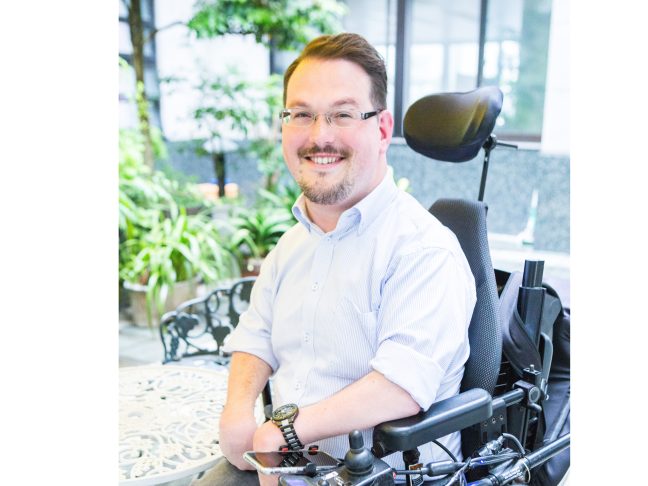
Josh
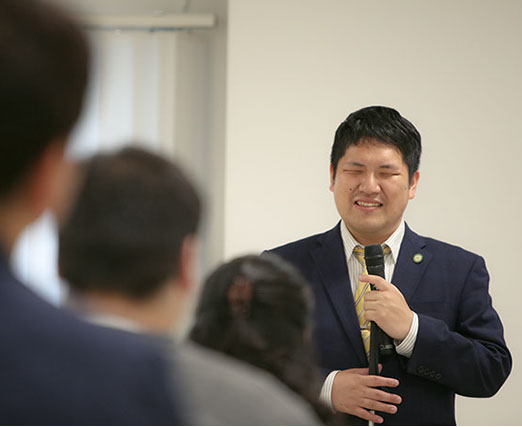
Image of universal manners certification training
■Key initiatives
1. Conducting interviews with disability support organizations and wheelchair users living in Japan to better understand what international travelers with disabilities seek when visiting Japan.
2. Ensuring that all employees obtain the Universal Manners Certification (Level 3), which fosters the ability to act with empathy by seeing the world from perspectives different from one’s own.
3. Gradually creating and publishing on our website accessible route maps for wheelchair users, as well as facility guides presented from a wheelchair user’s perspective.
Many travelers with disabilities, including wheelchair users, often travel with the support of family members or friends. As MIMARU is well-suited for group stays, we will continue advancing these initiatives to ensure that guests can visit Japan with greater peace of mind and enjoy a comfortable travel experience.
■ What we learned from our interview with Josh, a wheelchair user living in Tokyo
Josh, who shares travel accessibility information online for international visitors, has been living in Tokyo using a wheelchair since 2007. Drawing on his personal experience, he created and operates the Japanese tourism website “ACCESSIBLE JAPAN.”
He provided us with valuable insights on topics such as the progress of accessibility in Japan, effective ways to share information with international guests with disabilities, and areas where accommodation facilities can further improve. Below are some of his key recommendations.
Accessibility in transportation is advancing in Japan, but information for international visitorsremains limited
・ Compared to many other countries, Japan has made significant progress in improving accessibility in public transportation. In Tokyo, nearly 96% of train stations are now accessible, and Osaka achieved similar milestones even earlier.
・ Shrines and temples have also been improving accessibility by removing gravel paths, installing ramps, and adding elevators. However, this progress is not widely communicated to international travelers with disabilities. When they see images on social media of shrines deep in forests or crowded trains, they may assume, “I won’t be able to go there.”
・ Accessibility in shops and restaurants still has room for improvement. Some entrances lack ramps, certain tenants in multi-use buildings are unable to renovate their spaces, and accessible restrooms are not always available.
Accessibility information for hotels is often incomplete on official websites
・ When looking for accessible accommodation, travelers often ask friends, check social media, and search booking websites. However, the information available is sometimes unclear or unreliable. In many cases, they ultimately visit the hotel’s official website and make direct inquiries. Providing comprehensive accessibility information on the official website can significantly reduce the burden and anxiety associated with confirming details.
・ The most important element of any trip is the accommodation. When making a reservation, guests need to confirm key details such as the location, the orientation of the toilet, the height of the bed (whether it is higher or lower than a wheelchair, as larger gaps can make transfers difficult), the price, and whether shuttle services are available.
・ The presentation of information on the official website is crucial. Features such as 360-degree virtual tours, floor plans, and detailed photographs that clearly show furniture height and width — as well as the direction of the toilet — are especially important.
Strong interest in traveling to Japan — Tokyo, Osaka, and Kyoto remain top destinations
・ Travelers with disabilities have the same interests and preferences as anyone else. Some are passionate about Japanese anime and express a strong desire to visit Japan, while others actively travel abroad on a regular basis.
・ Tokyo, Osaka, and Kyoto remain the most popular destinations. As accessibility information becomes more widely available, interest in visiting cities beyond these three is also growing. Many would like to explore regional areas; however, transportation options can be limited — sometimes only highway buses are available, and local transportation to tourist sites is often insufficient once they arrive.
International guests with disabilities tend to stay longer and rarely travel solo
・ Guests with disabilities often have longer stays compared to non-disabled travelers, as mobility can require additional time and may be physically demanding. For example, using restrooms while traveling can be challenging, and some individuals may limit food intake prior to departure. As a result, they may arrive in a state close to dehydration and spend their first day resting in their room to recover.
・ Solo travel among wheelchair users is relatively rare, accounting for only 12.6%*. Most travel with a partner, family members, or in groups of two or more. In addition to accommodating multiple guests, sufficient room space is essential to allow for wheelchair mobility, making larger guest rooms particularly important.
*Source:https://wheelchairtravel.org/
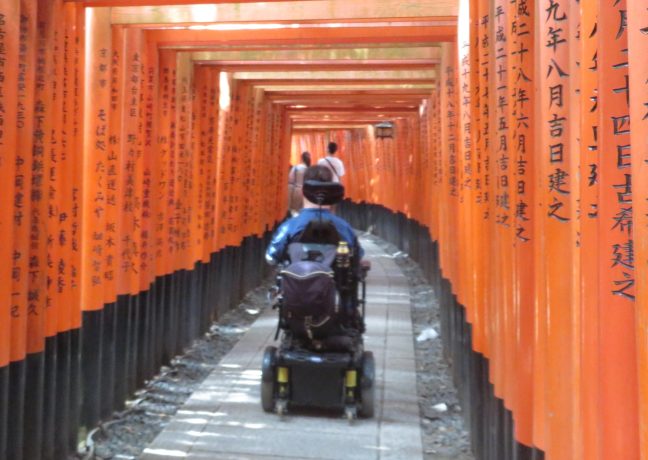
rofile: Joshua Grisdale
Born in 1981 in Canada, Joshua Grisdale has lived with spastic cerebral palsy since early childhood and has used a wheelchair since the age of four. He moved to Japan in 2007.
Professionally, he has been involved in creating Japanese-language websites for nursing care facilities, retirement homes, kindergartens, and daycare centers. In his personal time, he operates “Accessible Japan,” a tourism website dedicated to providing travel information for international visitors with disabilities.
He acquired Japanese citizenship in 2016.
ACCESSIBLE JAPAN: https://www.accessible-japan.com/
■ About the Universal Manners Certification
The Universal Manners Certification (Level 3) is an introductory program designed to teach fundamental approaches and communication methods for engaging respectfully with people with disabilities, older adults, and others who may require additional consideration. The certification is operated by Mirairo Inc., a comprehensive universal design consulting company headquartered in Osaka (CEO: Toshiya Kakiuchi).
This certification provides systematic training in both the mindset and actions necessary to practice universal manners. Participants begin by learning about the characteristics and psychological perspectives of diverse individuals, and then study appropriate ways to offer support in daily life and customer service settings.
At MIMARU, we are committed to fostering the right mindset among our employees so that they can warmly and respectfully welcome each and every guest from around the world. By acting from the perspective of guests with disabilities, we aim to create a hotel where everyone can feel safe, comfortable, and genuinely welcomed.
Universal Manners Certification: https://universal-manners.jp/about
■ Accessible route maps and wheelchair-level facility guides
At MIMARU, we are creating and gradually publishing on our website accessible route maps that outline the path from the nearest train station to each hotel from the perspective of guests with disabilities.
We are also preparing detailed guides that provide information on shared facilities and selected guest room types from a wheelchair user’s viewpoint, highlighting the features most relevant to accessibility.
Related Release: https://mimaruhotels.com/news/sustainability_3/
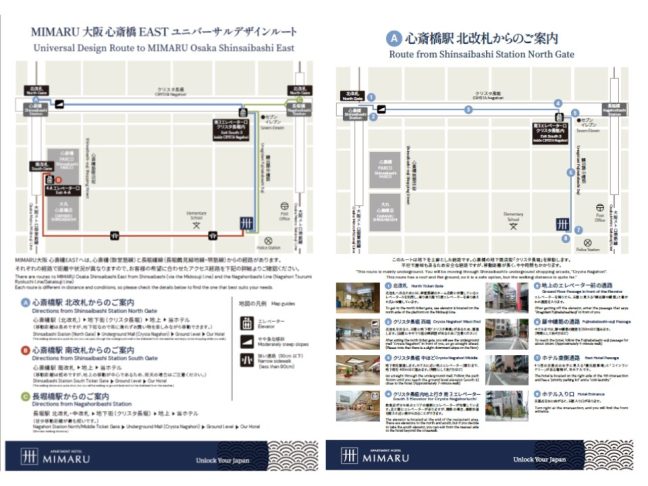
Accessible route map
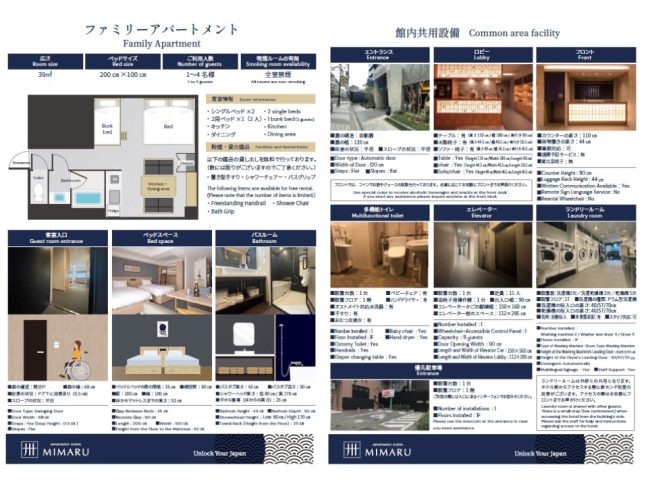
Facility information
※Translated by MIMARU